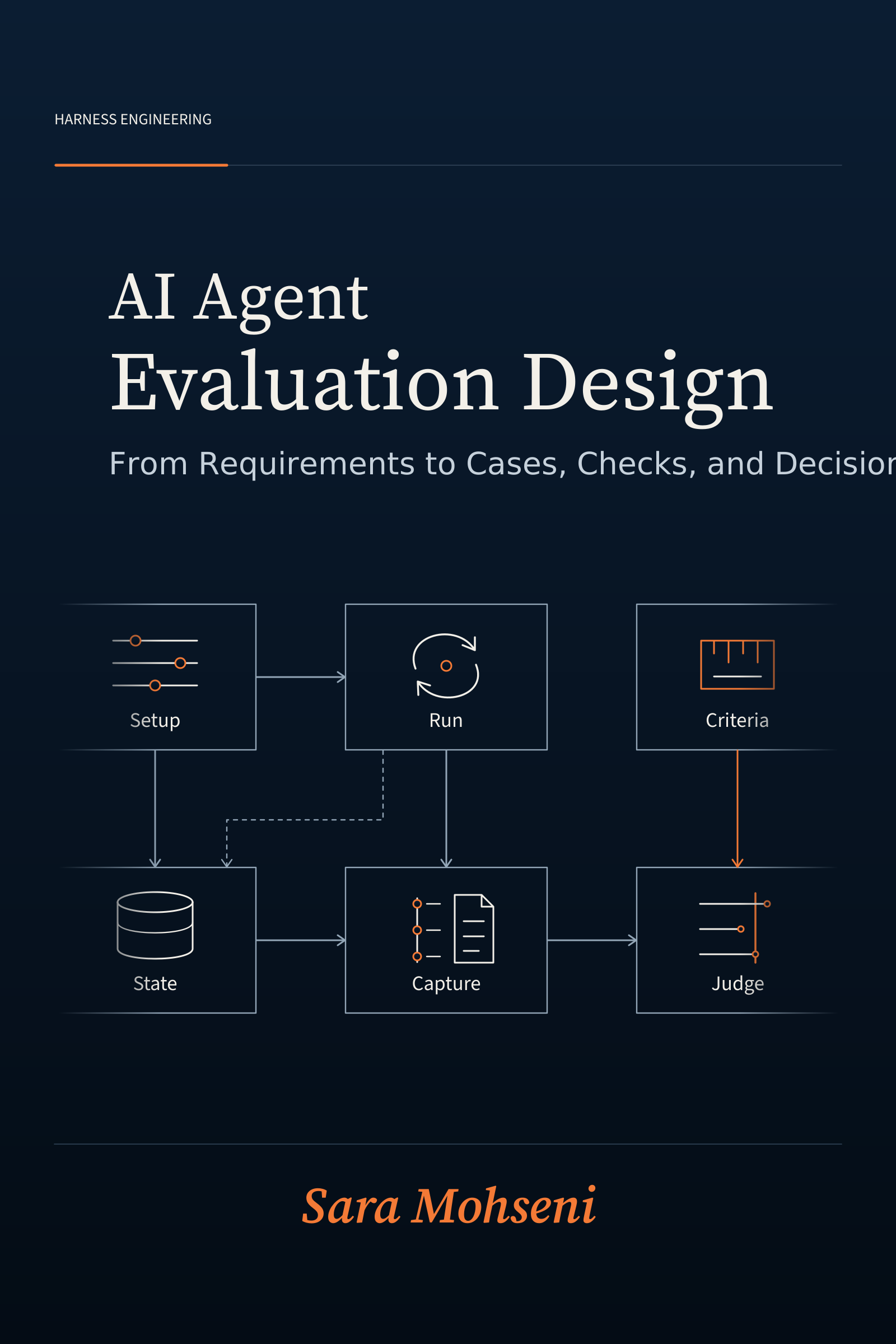
Book by Sara Mohseni
AI Agent Evaluation Design
From Requirements to Cases, Checks, and Decisions. Read the contents, preface, and opening chapter on the book page.
Explore the book →Harness Engineering Series
The part of the job that starts after the tests pass, and the reason an agent that passed every one of them still broke on Monday.
Harness engineering is the discipline of building the machinery around an AI agent rather than the agent itself. The prompt is usually about forty lines. Almost everything that decides whether the thing can be trusted sits outside it.
The name is borrowed from how engineers have always handled something powerful they cannot fully predict. Nobody takes an engine's word for its own output. They build a test harness around it, with instruments on what comes out, load on what goes in, and alarms on every limit that matters. The engine supplies the power. The harness is what lets you say you know.
An agent is an engine in exactly that sense. It is non-deterministic, it is persuasive when it is wrong, and it will answer the same question five different ways. A test suite written by the same person who wrote the prompt cannot see any of that, which is why 340 passing tests on a Friday tell you nothing about the 43 tickets waiting on Monday.
Teams believe the job is prompting, and the market sells them the engine. But the engine was never the hard part. You cannot trust what you cannot measure, and nothing about an agent is measurable until you build the thing that measures it.
A harness is what you build once you know what you are testing for. If that part is still open, start with what AI evals are and come back.
AI Agent Evaluation Design follows the work from requirements to cases, evidence, judgments, and a working evaluation harness.
Book by Sara Mohseni
From Requirements to Cases, Checks, and Decisions. Read the contents, preface, and opening chapter on the book page.
Explore the book →Each one takes a single piece of the harness and goes at it on its own.
Agentic engineering is building the machinery around the model, not the model. What the term means, the four places it breaks, and the half nobody budgets for.
AI evals get filed as an engineering chore. Four of the decisions inside them are product decisions, and handing those to engineering is how quality drifts.
Most teams treat AI agent evals as an afterthought. Your eval set is the product: how to build failure cases that survive every model swap.
"Is it ready?" is a circular meeting until you define the bar. The four lines that make a production-ready AI agent a number, not a vibe.
An agent won't give the same answer twice, so one green eval run is a coin flip. How to measure AI agent reliability as a distribution, not a pass.
You can't stop an agent from ever being wrong. AI agent guardrails, human-in-the-loop, and blast radius: how to contain the failure you can't prevent.
An accurate agent still dies in review if it is too slow or too expensive. How to budget AI agent cost and latency per successful task, not per call.