Is the Gap Between Staging and Production Really the Data?
Staging matches production on schema and infra, then lies about the data. Why the staging vs production gap is about shape, not size, and how to close it without copying prod.
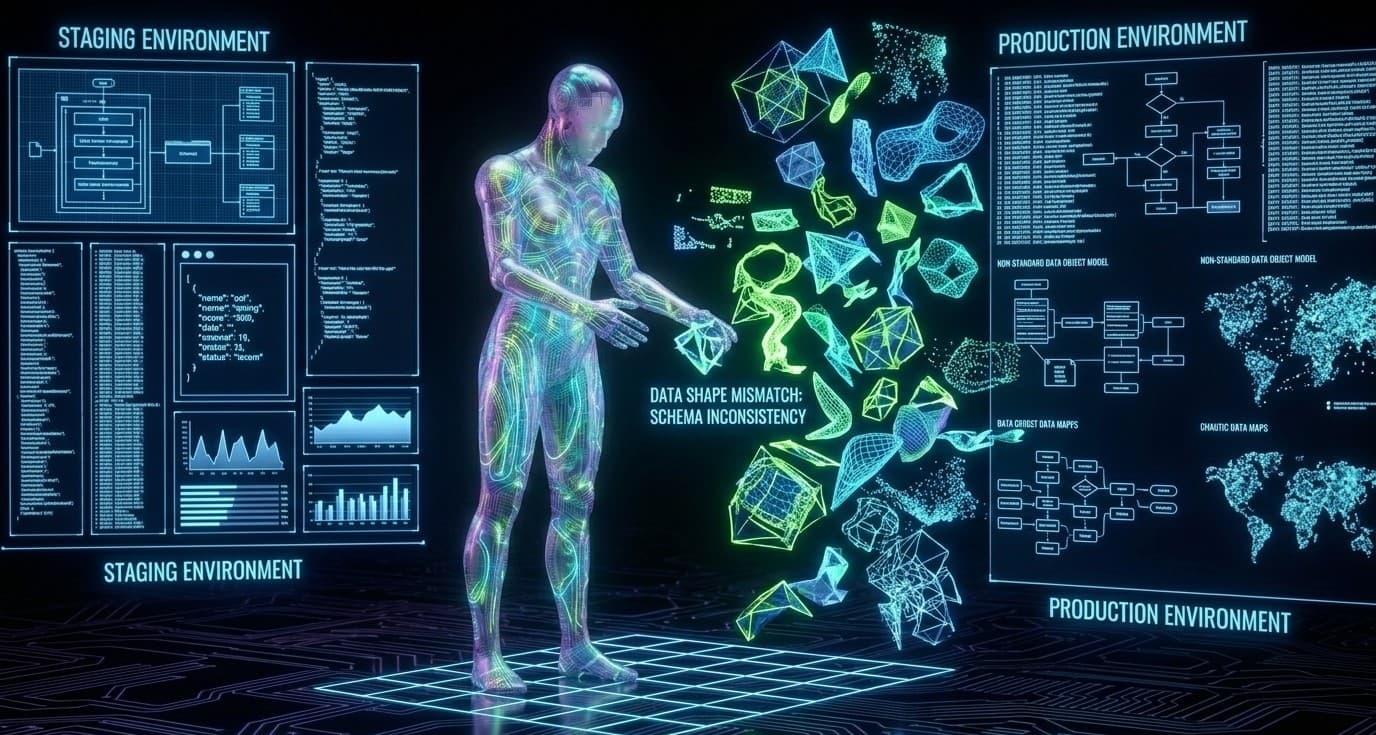
Everyone has shipped the bug that only exists in production. It passed every test. It worked in staging. Then a real user hit it in the first hour, and when you looked, the cause was not the code. It was a row shaped like nothing you had ever tested against.
We treat this as bad luck, or as proof that staging is never quite good enough. It is neither. Staging matches production on almost everything that is easy to match, and lies about the one thing that is hard. The Twelve-Factor advice to keep environments similar has mostly won: same database engine, same version, same container, migrations run in the same order. Parity of infrastructure is close to solved. Parity of data is not, and the data is where the bugs live.
The staging vs production data gap
Here is the difference nobody closes. Your staging data was born yesterday. Someone wrote a seed script, or clicked through the UI a few times, and everything in there is clean, recent, and shaped exactly the way the person who made it imagined the world. Production data is a fossil record. It remembers the migration from three years ago that left half the rows with a null in a column that is now required. It has the user who put an emoji in their legal name, the order with a negative quantity from the refund bug you already fixed, the account created before you added the field everything now assumes.
Production data is not just bigger than staging data. It is older, weirder, and full of history that no one would ever think to write into a fixture, because you only get that history by living through it. Staging tests the world as you imagine it. Production is the world as it actually accreted.
Stop trying to make a smaller production
The instinct is to close the gap by copying. Pull a dump of production into staging and now the data is real. It works, and it is a mistake, because you have just spread every piece of customer PII across an environment with weaker access controls, more people, and looser logging. You solved a testing problem by manufacturing a privacy incident waiting to happen.
The goal was never a copy of production. It was data with the same shape as production. The same distributions, the same edge cases, the same nulls and outliers and impossible-looking rows, without the same real people attached. You want the fossil record without the fossils' names. That is a generation problem, not a copy problem: realistic, reproducible data you can regenerate identically for every environment, carrying production's weirdness and none of its liability.
Next time staging lies to you, do not ask for a bigger staging. Ask what shape of row production has that your seed script would never invent.
Staging isn't a smaller production. It's a fictional one. The gap was always the data.